For a brief time, artists come together to inhabit a shared space. A temporary republic founded on encounter, trust, experimentation, and the freedom to not yet know.
Independent Art Republic begins with a simple idea: that art can create a territory of its own.
For a brief time, artists come together to inhabit a shared space, not as citizens of different nations, disciplines, or generations, but as bodies, voices, and imaginations in relation. IAR is less a place than a condition: a temporary republic founded on encounter, trust, experimentation, and the freedom to not yet know.
Here, mentorship does not mean direction. It means proximity, attention, and the creation of space for something unforeseen to emerge. The artistic process is allowed to remain porous, unstable, unfinished. Error, imperfection, and failure are not interruptions, but possible openings, places where another language can begin.
What remains is not only the work produced, but the experience of being together: conversations, gestures, silences, shared time. Independent Art Republic imagines art as a common ground, fragile and temporary, but capable of producing new forms of belonging.
The painting questions the sense of security associated with marriage and its traditional promises of love, understanding, care, and mutual support. Rather than depicting a couple in harmony, the figures are positioned to make the tension between them palpable.
The composition is symbolically divided into two parts, with the void between the figures representing the emptiness within the relationship. The work is part of a broader research project centred on the Croatian film As Long as I Laugh (Samo dok se smijem).
02Anđela KopanjaBodies Tumbled into Bodies
Bodies Tumbled into Bodies
Spatial installation, 3D-printed object, video animation on LED display, and sound
The work explores the relationship between an organic body and its synthetic and digital forms. Beginning with a dried oak leaf, Kopanja examines a state of transition between vitality and decay.
Through 3D scanning, digital translation, and 3D printing, the leaf is transformed into a new material form. Its silver shell preserves its outline while simultaneously distancing it from its original organic state. Beneath the sculpture, an LED display presents an animated reflection, evoking the surface of water.
The physical and digital bodies emerge through their relationship, raising questions about transformation, interconnectedness, and the persistence of life through changing forms.
The series investigates the relationship between colour and the material that carries it. Working on untreated jute, Aranitović allows the paint to penetrate the fibres rather than remain as a separate layer on the surface. The texture and irregularities of the fabric become integral to each coloured field.
The arrangement of the six works establishes relationships of proximity, distance, rhythm, and interruption, transforming individual paintings into a larger spatial composition.
The animation follows an apple travelling through different parts of an ethno village, navigating obstacles and varied terrains in an attempt to reach water. Throughout its journey, the apple gradually transforms, appearing in different states of freshness before becoming completely dried.
Through this sequence of movements and changes, Milutinović explores the relationship between space, time, transformation, and transience.
The work explores multilayered memory through a form developed from the artist’s childhood photograph and personal experiences. The photograph itself is removed from the composition, leaving behind voids that continue to shape the surrounding structure.
By reconstructing and relocating these absences, Aydoğmuş examines how the past continues to influence the present. Traces on the surface represent the effects of what has disappeared but remains active in memory. Absence becomes not a passive lack, but a form of presence that transforms over time.
The work explores the temporary and unreliable nature of safety and belonging. Drawing on personal experiences of moving between countries and social circles, Milatović considers the possibility of having multiple foundations for one’s identity.
The fragile, erasable quality of charcoal reinforces the provisional nature of the shelter depicted. Its improvised structure suggests that safety can emerge in uncertain circumstances, while the dreamlike surroundings evoke the memories and feelings of comfort that make a place feel like home.
The performance uses a form of play involving physical conflict, replacing cushions with soft baseball bats. Through this shift in materials, an object associated with aggression becomes a means of collective entertainment, while its softness neutralises the potential for violence.
The work examines the boundaries between play, aggression, and socially acceptable physical confrontation.
Performers: Angelina Krunić, Heather Susannah Roach, Julia Vasconcelos, Tatjana Ružić, Zorana Stevanović
The performance begins with the act of hitting a car, directing an aggressive gesture towards an object associated with material value, status, and prestige. The use of soft baseball bats creates a contradiction between the appearance of violence and the absence of actual destruction.
The work examines the relationship between material value, status, and the fantasy of destruction.
Performers: Angelina Krunić, Heather Susannah Roach, Julia Vasconcelos, Tatjana Ružić, Kaja Đoković, Aleksandra Milutinović, Zorana Stevanović
Love Letter to Romeo
Sculpture/installation: car frame and soft sculptural bats
The installation explores the symbolism of aggression and the potential for violence. The soft baseball bats retain the visual language of threat while being deprived of their ability to injure, creating a tension between the suggestion of violence and its physical neutralisation.
Vasconcelos meets Serbian artist Aleksandra Milutinović to learn kolo, a traditional folk dance deeply rooted in Serbian cultural memory. Through gestures, steps, observation, and repetition, the artists attempt to establish a shared understanding beyond spoken language.
Performed on sand, their movements leave temporary traces of an encounter shaped by hesitation, adjustment, and the gradual negotiation of a shared rhythm. The work reflects on communication across linguistic and cultural differences and on the ways knowledge can be embodied and transformed through learning.
The performance explores how traditional dance is transmitted and transformed through collective participation. Beginning with a single body and live music, the choreography gradually expands as others join, observing and repeating the movements around them.
Each repetition introduces subtle changes, making the dance a continually evolving form rather than a fixed reproduction. Through the participation of the artist, local community members, and other performers, the work examines how cultural gestures travel between bodies, negotiating questions of ownership, belonging, and transformation.
Zastava, meaning “flag” in Serbian, explores symbols and icons inherited from the past. The work is a silicone cast of a Yugo 45 car door, referencing the automobile produced by the Zastava factory in Kragujevac and its status as a symbol of Yugoslav identity.
By transforming a rigid metal object into a flexible, transparent form, Roach reflects on how national symbols and collective histories can change while leaving material and emotional traces. The work also connects these questions of shared history to contemporary geopolitical realities and the circumstances that shaped its material development.
10Kaja ĐokovićGround
Ground
Triptych, three paintings; acrylic on canvas and red LED light installation
Ground is an abstract installation developed in response to the surrounding landscape. The paintings translate impressions of the environment through colour, atmosphere, and organic forms, while a red light moves across the works as an artificial signal.
The colour evokes fire and recalls recent wildfires in Serbia, introducing a sense of vulnerability into the landscape. The installation explores the relationship between nature and technology, human intervention, and environmental change.
The work explores the space between form and formlessness, matter and void. Drawing on processes of cellular division, repetition, and differentiation, Lajić investigates how forms emerge, transform, and recombine. The sculpture resists a fixed interpretation, occupying an ambiguous territory between recognisable material structures and abstract configurations.
Its whiteness intensifies this uncertainty, allowing distinctions between object and void, interior and exterior, and material and immaterial to become less stable. Abstraction becomes a means of approaching reality differently, suggesting alternative forms of existence that cannot be fully defined or resolved.
The work reflects on cultural appropriation, representation, and the limits of hospitality. Beginning with the artist’s research into Serbian history and the cultural practice of slava, particularly the ritual of breaking bread by hand, the work examines the position of an outsider engaging with a culture that is not their own.
Through reflections on hospitality, institutional influence, and the representation of other voices, the artist questions whether artistic practice can ever be entirely free from the structures it seeks to resist. Rather than offering a definitive conclusion, the work turns this uncertainty back onto the artist, framing the piece as an examination of personal contradictions rather than a confession.
Ilyad consists of a photographic image transferred onto rock segments that form a single work. The image documents forest fires that engulfed Maglič in western Serbia during the summer of 2026.
Taken by a friend of the artist who volunteered in firefighting efforts, the photograph becomes a starting point for examining environmental entropy and the relationship between natural processes and human intervention. The work also draws on discussions about the disappearance of wild horses in Bosnia and Herzegovina, raising questions about the changing conditions of natural environments and the boundaries between human and natural transformation.
The work explores memory, diaspora, absence, and the experience of returning to a place that no longer functions as it once did. Rooted in memories of the artist’s grandparents’ house and the summers spent there, the sculptures transform domestic objects into traces of a life that has stopped.
The first is a traditional Smederevac wood-burning stove filled entirely with concrete, its doors opening onto a solid wall. The second is an old suitcase, also filled with concrete, bearing the imprint of a džezva and coffee cups associated with hospitality and family rituals.
By preserving these objects while rendering them unusable, Ružić reflects on the tension between remembering a home and accepting that the life once lived there cannot be recovered.
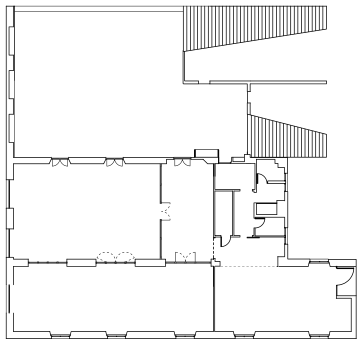
03 / Exhibition map
Find your way through the exhibition.
04 / Visit
Visit Independent Art Republic
19 — 24 OCT 2026 RUFA Space Via degli Ausoni 7A, Rome